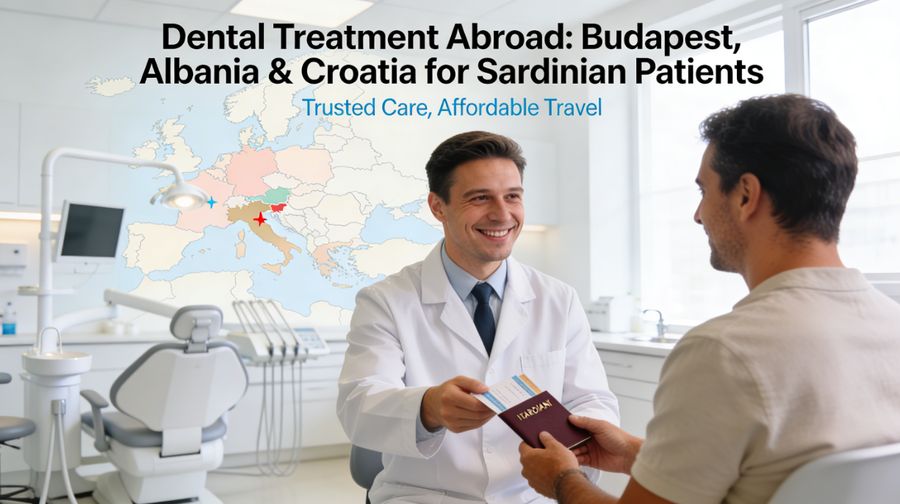
Sardinian patients who consider dental treatment abroad usually look for three things: reliable quality, clear communication, and a real saving compared to Italy. In this context Budapest in Hungary, together with Albania and Croatia, has become one of the main reference points for complex dental work such as implants and full-mouth rehabilitation.
Why Sardinians look abroad for dental care
For many families in Sardinia, major dental work such as implants, bridges, or complete prosthetic rehabilitation can become financially heavy, especially if several teeth are missing or there are long-standing problems. At the same time, the local offer is sometimes limited for advanced full-arch implant dentistry, or involves long waiting lists and higher private prices.
Abroad, and especially in Central and Eastern Europe, clinics work with lower operating costs and can therefore offer complex treatments at more accessible prices while maintaining high clinical standards. This is why many Sardinian patients choose to travel for:
-
Implantology (single implants, All-on-4, All-on-6).
-
Zirconia or metal-ceramic crowns and bridges.
-
Aesthetic dentistry (veneers, full smile makeover).
Often, the trip becomes an opportunity to combine treatment with a short holiday in a European city such as Budapest, Zagreb, or Tirana.
Budapest, Hungary: strong point for Sardinian patients
Budapest has been one of Europe’s capitals of dental tourism for years and today remains one of the most structured destinations for Italian and Sardinian patients. Hungarian clinics are used to working almost exclusively with foreign patients and have built up specific experience in managing complex cases in a few, well-planned trips.
Main advantages for Sardinian patients choosing Budapest include:
-
High specialization in implantology and full-mouth rehabilitation, with modern equipment, digital diagnostics, and 3D planning.
-
Stable prices significantly lower than private care in Italy, especially on implants, bridges, and long prosthetic work.
-
Italian-friendly organization: many clinics offer Italian-speaking staff, translated documents, and dedicated support for travel logistics.
Even if there are not always direct flights all year round between Sardinia and Budapest, connections via major Italian hubs make the trip manageable, especially for treatment phases concentrated over a few days.
Typical treatments in Budapest
For Sardinian patients, the most requested treatments in Budapest are:
-
Single implants to replace one or a few missing teeth.
-
All-on-4 / All-on-6 for complete arches in one or both jaws.
-
Combined therapies: extractions, bone grafts, sinus lifts, and immediate temporary prosthesis in the same trip.
The pathway is usually organized in two or three visits: first for diagnostics and surgery, then for final prosthetic work after the osseointegration period, and finally for optional check-ups or refinements.
Travel and stay
Clinics in Budapest that work with international patients often help with:
-
Choice of flights and dates according to the treatment plan.
-
Hotel or apartment close to the clinic, sometimes with agreed rates or included nights.
-
Transfers between airport, hotel, and clinic where needed.
For Sardinians who are used to traveling to the mainland for specialist visits, adding one more flight to Budapest often becomes a sustainable step if the total saving on dental care is relevant.
Albania: advantages and limits for Sardinian patients
Albania has grown very quickly as a destination for Italian dental tourism, especially thanks to competitive prices and the strong presence of Italian-speaking staff in clinics in Tirana and other main cities. Many centers are built specifically for foreign patients and focus heavily on implantology and full-arch rehabilitation, with modern technologies and organized support services.
The main strengths of Albania are:
-
Very marked cost reduction on complex treatments compared to Italy, particularly on implants and prosthetic bridges.
-
Strong language and cultural affinity: doctors and coordinators often speak fluent Italian and follow the patient step by step.
-
Short times between first contact, estimate, and start of treatment.
However, for Sardinian patients, Albania has some practical limits:
-
The journey almost always requires a change of plane via mainland Italy or other hubs, with travel times similar to or longer than Budapest.
-
Not all clinics have the same history and structure in the management of guarantees and long-term follow-up for foreign patients, an aspect that must be carefully evaluated.
For patients who place maximum value on price and speak Italian but not necessarily English, Albania can be an option, provided the clinic is chosen carefully and with attention to experience, documentation, and guarantee policies.
Croatia: EU standards and tourist appeal
Croatia has invested heavily in dental tourism and today welcomes many patients from all over Europe, particularly for implantology and cosmetic treatments. Clinics in cities such as Zagreb and coastal locations operate under European Union regulations, with modern structures and multilingual staff.
For Sardinian patients, the attractions of Croatia include:
-
Prices for single implants and complex prosthetic work lower than in Italy, though often slightly higher than in Albania and sometimes comparable to Hungary.
-
EU-level quality and safety framework, with clear standards, traceable materials, and recognized protocols.
-
Tourist appeal of coastal towns and the possibility of combining treatment with a seaside or cultural holiday.
On the other hand, travel logistics from Sardinia tend to involve at least one change, and the number of clinics structured specifically for Italian patients is smaller than in Hungary or Albania, where Italian has become the main working language for many centers.
Budapest vs Albania vs Croatia for Sardinian patients
Below is a practical overview of the three main destinations for a Sardinian patient evaluating dental treatment abroad.
| Aspect | Budapest (Hungary) | Albania | Croatia |
|---|---|---|---|
| Main focus | Implantology, full-mouth rehab, prosthetics. | Implantology, All-on-4/6, cosmetic work. | Implants, cosmetic treatments, prosthetics. |
| Typical savings vs Italy | Significant on major works, often 40–60% on implants and full arches. | Very high savings on complex cases, often among the lowest prices in Europe. | Savings up to about 50–70% vs some Western markets, lower but still relevant vs Italy. |
| Experience with Italian patients | Long tradition, dedicated programs and Italian-speaking staff in many clinics. | Very high, with clinics almost entirely oriented to Italian patients and Italian language. | Good but more heterogeneous, with multilingual staff especially in larger centers. |
| Travel from Sardinia | Usually via hubs such as Rome or Milan, with connections to Budapest. | Often via mainland Italy or other European hubs, similar or longer total travel time. | Requires at least one stop; some seasonal combinations may be convenient. |
| Regulatory framework | EU country, strong standards, modern equipment, advanced protocols. | Rapidly evolving system, modern private clinics focused on international patients. | EU country, strict standards and widespread digital technologies. |
| Follow-up and guarantees | Structured for foreign patients, clear guarantees and medium-long term follow-up. | Good organization in clinics oriented to Italian patients, but quality varies, so choice is important. | Reliable in established centers; conditions should always be checked before starting. |
How to choose the right clinic abroad
Regardless of destination, the success of dental treatment abroad depends largely on the clinic chosen and the clarity of the treatment plan. For Sardinian patients, a prudent choice often begins with a detailed remote assessment based on panoramic x-rays or 3D CT scans sent by email.
Key points to check before deciding:
-
Qualifications and experience of the implantologist and prosthodontist, especially for complex rehabilitations.
-
Use of certified materials (implants, prosthetic components, ceramics) with traceable documentation.
-
Clear written treatment plan with phases, timing, and economic details.
-
Policy on guarantees, management of complications, and possible need for future trips.
Well-organized clinics provide a clear timeline that helps patients from Sardinia plan days off work, flights, and accommodation without surprises. The most serious structures also collaborate with local dentists for small post-operative checks, to avoid unnecessary trips abroad for minor follow-up visits.
Travel planning for Sardinian dental tourists
For Sardinian patients, organizing a dental trip requires a bit of extra planning, but once the treatment plan is defined, logistics usually become routine. The most common route is a flight from Cagliari or another Sardinian airport to an Italian hub such as Rome or Milan, followed by a direct connection to Budapest, Tirana, or a Croatian city.
To optimize costs and comfort it helps to:
-
Book flights in advance, choosing weekdays and mid-season periods when fares are lower.
-
Coordinate treatment sessions so that as much work as possible is concentrated in a single trip, within the limits of clinical safety.
-
Use clinics that offer help with accommodation and transfers, reducing stress once at destination.
Many patients choose to extend their stay by one or two days after major interventions to allow for checks and adjustment before returning to Sardinia, combining necessary rest with the pleasure of visiting the city.
For whom Budapest is the best option
Budapest is particularly suitable for Sardinian patients who:
-
Need medium or large implant-prosthetic work and want a balance between savings and very high technical level.
-
Prefer an EU setting, with recognized standards and a long history in dental tourism.
-
Appreciate the support of Italian-speaking staff and an organization accustomed to following international patients from the first contact to final check-ups.
Albania and Croatia remain valid options, especially for those who prioritize maximum price competitiveness or want to combine dental care with a particular type of holiday, but Budapest offers a particularly strong combination of reliability, structured pathways, and quality/cost ratio that fits well with the expectations of many Sardinian patients.