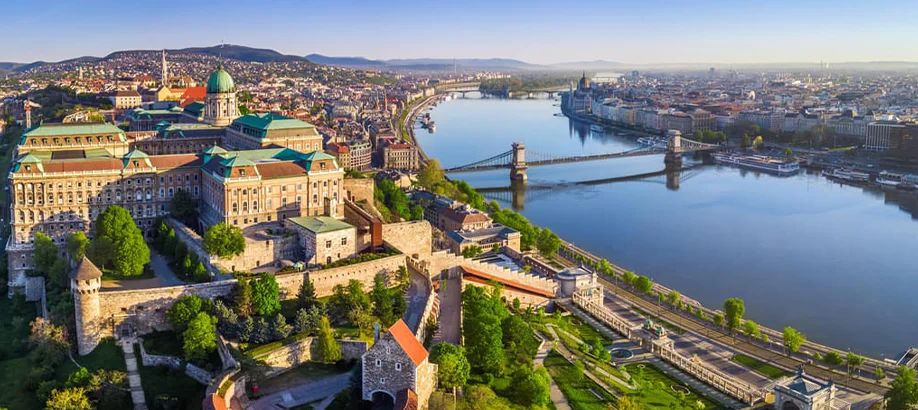
Hungary is a small Central European country with a long, complex history, a distinct language and culture, and an impressive record of scientific and artistic achievement, including a remarkable number of Nobel Prize winners.
Basic facts: Time, currency, geography
Hungary lies in Central Europe, bordered by Austria, Slovakia, Ukraine, Romania, Serbia, Croatia and Slovenia, with Budapest as its capital and largest city. The country is in the Central European Time zone (CET, UTC+1) and switches to Central European Summer Time (CEST, UTC+2) from late March to late October.
The national currency is the Hungarian forint (HUF); although card payments are widespread and euros are sometimes accepted in tourist areas, the forint remains the only legal tender. Hungary has been a member of the European Union since 2004 but has not adopted the euro, so visitors should expect prices and ATM withdrawals in forint.
Language and identity
Hungary’s official language is Hungarian (magyar), a Finno‑Ugric language unrelated to the surrounding Indo‑European tongues and considered one of Europe’s most distinctive major languages. It uses the Latin alphabet with several additional accents and has a rich literary and folk tradition that plays a central role in national identity.
Most citizens identify as ethnically Hungarian, with historic minority communities such as Roma, Germans, Slovaks, Croats and others; the constitution emphasises the continuity of the Hungarian nation and its cultural heritage. English and German are the most common foreign languages, especially in Budapest and among younger generations.
Citizenship and the Hungarian diaspora
Hungarian citizenship is primarily based on the principle of jus sanguinis (right of blood): children of at least one Hungarian citizen parent can acquire citizenship regardless of birthplace. In recent years, simplified naturalisation has allowed many people of Hungarian descent in neighbouring countries and the wider diaspora to obtain or reclaim Hungarian citizenship while often retaining another nationality.
This extensive diaspora, created by historical border changes and emigration, helps explain why many “Hungarian” Nobel laureates were born in what is now other countries or later became citizens of states such as the United States, Israel or Germany while maintaining strong Hungarian ties.
Famous Hungarians in science and culture
Hungary has produced an outsized number of influential scientists, artists and thinkers relative to its population. Often‑cited famous people examples include physicist Eugene Wigner, holography pioneer Dennis Gabor, and author Imre Kertész, alongside mathematicians and engineers nicknamed the “Martians” of Budapest for their brilliance in 20th‑century science and technology.
In culture, modern Hungarian literature and music have global resonance: writers like László Krasznahorkai and composers such as Béla Bartók and Zoltán Kodály are widely regarded for combining national traditions with modernist experimentation.
Hungary’s Nobel Prize winners
Hungarians and people of Hungarian origin have received Nobel Prizes across almost all categories except Peace, with well over a dozen laureates recognised by the Hungarian Academy of Sciences. Early figures include Philipp Lenard (Physics, 1905), Robert Bárány (Physiology or Medicine, 1914) and Richard Adolf Zsigmondy (Chemistry, 1925), whose work helped shape modern physics, medicine and colloid chemistry.
Later laureates include Albert Szent‑Györgyi (Physiology or Medicine, 1937) for discoveries related to vitamin C, George de Hevesy (Chemistry, 1943) for isotope tracer techniques, Georg von Békésy (Physiology or Medicine, 1961) for inner‑ear research, and Eugene Wigner and Dennis Gabor in Physics for symmetry principles and holography respectively. In the late 20th and early 21st century, John Harsanyi (Economics, 1994), George A. Oláh (Chemistry, 1994) and writer Imre Kertész (Literature, 2002) further expanded this list, followed by more recent laureates of Hungarian birth or origin such as Katalin Karikó (Physiology or Medicine, 2023) and Ferenc Krausz (Physics, 2023).
This concentration of Nobel‑level work has helped construct an international image of Hungary as a country whose scientific and intellectual contributions far exceed its size, reinforcing its cultural brand as a land of “clever minds” in the heart of Europe.